

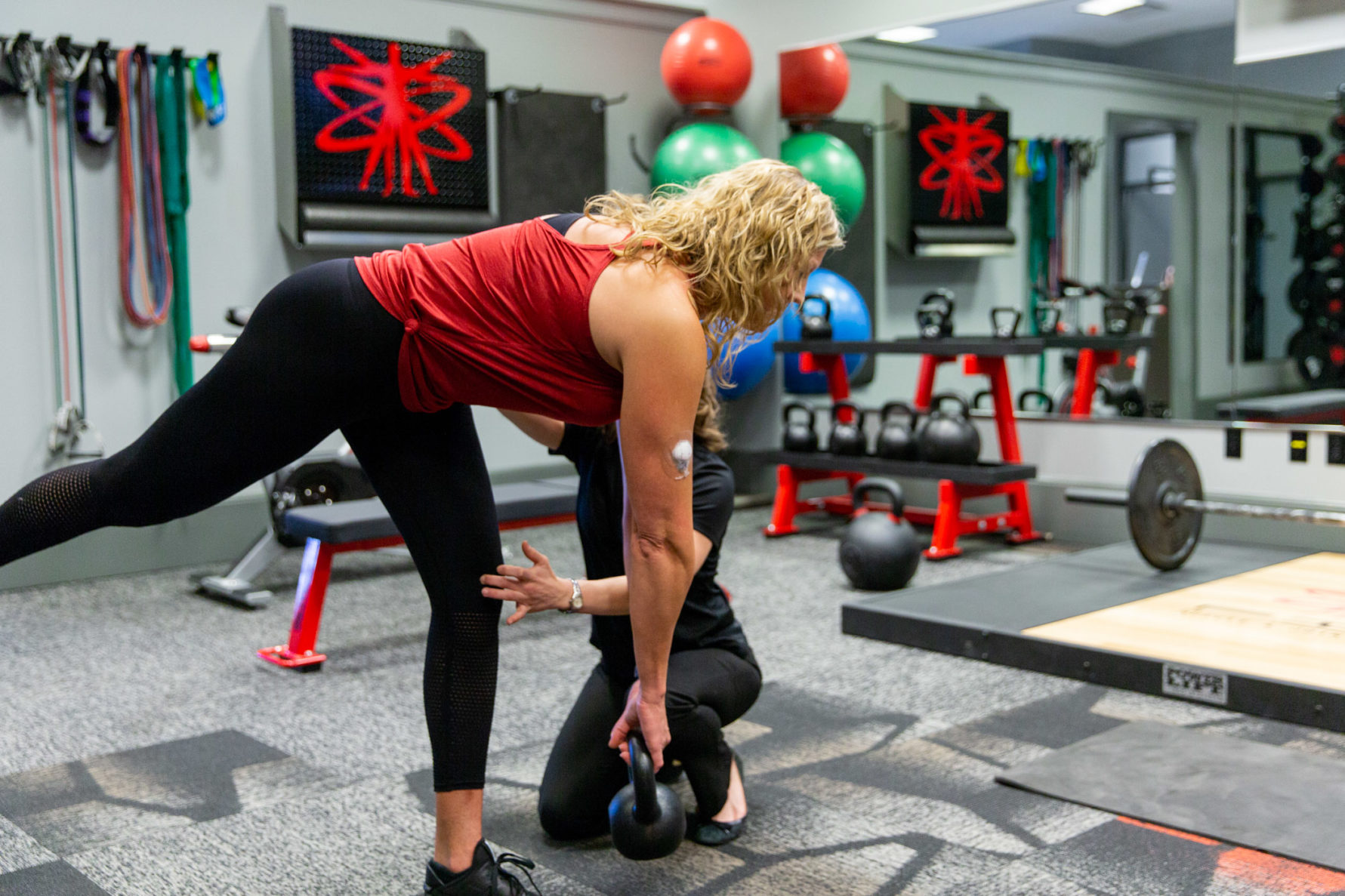

At F.I.T., pelvic floor specialists assess how pelvic floor health works alongside your hips, spine, breathing, and core. Then, we guide you through care that helps you move with more control and return to activity with confidence.
This Is More Common Than You'd Think
Pelvic Floor Therapy in Kansas City
Pelvic floor symptoms have a way of getting normalized. The leakage, the pressure, the postpartum recovery that never fully clicked, most people manage these things quietly for longer than they should. At F.I.T. we have providers with specialized training in this area, so they can evaluate the pelvic floor in the context of how your whole body moves.
These are some of the more common patterns we see. If your symptoms don’t fit neatly into one of these, that’s still worth letting our providers take a look at.
- Urinary leakage (or constipation or urgency affecting daily activities
- Pelvic, hip, or low back pain without a clear diagnosis
- Postpartum recovery that stalled after OB clearance
- Diastasis recti or core weakness following delivery
- Pelvic pain or discomfort affecting exercise or daily life
- Active adults and athletes managing symptoms that are limiting performance
- Tailbone pain with sitting
- Pregnancy pain
- Pain with intercourse


What Pelvic Floor Therapy Can Do
Reduce Pain & Pressure
Pelvic symptoms can make everyday movement feel tense and unpredictable. Treatment can help calm irritated tissue, reduce pressure, and make sitting, walking, lifting, and exercise feel more manageable.
Reconnect Strength & Control
Weakness and loss of coordination in the pelvic floor don't resolve on their own. Hands-on treatment combined with targeted rehab re-trains the stability and control that daily activity and performance require.
Return to Activity Safely
Your goal may be chasing kids without having to stop repeatedly, or maybe you just want to get through a workout without symptoms. Treatment at F.I.T helps you return with more confidence and less second-guessing.
Active Adults & Athletes
Pelvic floor symptoms don't only affect postpartum patients. Leakage during training, pressure with heavy lifts, or pain that flares with activity are all signs the pelvic floor needs attention. F.I.T. physical therapists understand both the pelvic floor and what your sport or training demands.
Those Dealing with Pelvic Pain & Dysfunction
Pelvic pain is one of the hardest things to get a straight answer on. Symptoms shift, imaging often comes back clean, and it's easy to end up with a diagnosis that doesn't quite fit. F.I.T. physical therapists work through what's actually contributing—not just what the symptom looks like on paper.
Postpartum & Pregnancy
Pregnancy and postpartum recovery change the way your core and pelvic floor respond. If you feel weak or unsure about getting back to exercise, pelvic floor therapy gives you a clearer path forward. Many people start pelvic floor therapy in Kansas City once symptoms don’t resolve on their own. Depending on your symptoms and where you are in pregnancy or postpartum recovery, we may coordinate with your OB before getting started..
Answers That Make Sense

What Treatment May Include
Pelvic Floor Evaluation
Your first visit includes a thorough evaluation. This includes your provider taking an hour to learn about your full history, perform a movement assessment, and soft tissue screening relevant to your specific symptoms and goals. From there, your provider looks at how your body responds to simple movement, breathing, and load before deciding what actually needs attention. For many patients, this is where strengthening their pelvic floor starts to make more sense.
Manual Therapy & Soft Tissue Work
Hands-on treatment is a core part of pelvic floor care at F.I.T. Our physical therapists use Active Release Technique and Instrument Assisted Soft Tissue Mobilization to release myofascial restrictions and reduce pain. Treatment may focus on the hips, abdomen, low back, or nearby muscle groups that influence pelvic floor function, depending on what your body shows.
Corrective Exercise & Rehabilitation
Exercise-based care at F.I.T. uses the Dynamic Neuromuscular Stabilization method. This is a rehab approach grounded in how the nervous system develops movement and stability. For pelvic floor patients, this means retraining breathing mechanics and the stability patterns that support the pelvic floor through real activity demands. Every appointment includes rehabilitation work.
Prenatal Chiropractic Treatment
Our prenatal certified chiropractors are trained in the Webster technique, the only chiropractic method specifically designed for pregnant patients. This technique looks different when compared to the ‘classic’ chiropractic adjustment, and utilizes a combination of maneuvers to help balance and mobilize the pelvis as it adapts to the growing baby. When used in combination with pelvic floor therapy, the Webster technique can do wonders for helping patients to have a more pain-free pregnancy and a smoother birthing experience.
Let’s Make Sense of This
You’re not expected to have the answers. Tell us what you’re feeling, and we’ll help you make sense of it.
Frequently Asked Questions
How long does pelvic floor therapy take to work?
It depends on what’s causing your symptoms and how long they’ve been there. Some people notice changes when their body starts responding differently to movement and pressure.
Others need more time to retrain patterns that have been off for months or years. Progress isn’t linear, and it shouldn’t feel rushed. The goal is steady improvement that holds up outside the clinic. That’s the focus of pelvic floor therapy in Kansas City at F.I.T.—change that actually lasts.
What if I’ve been dealing with this for a long time?
Symptoms like these tend to get pushed aside, adjusted around, or written off as something you just live with. Over time, your body adapts, but not always in a way that helps.
The longer a problem has been there, the more important it is to understand what’s changed underneath it. Even if it’s been years, pelvic floor therapy in Kansas City is still worth exploring—especially if nothing else has fully addressed it.
Will pelvic floor therapy just mean doing Kegels?
Definitely not. A weak pelvic floor does not always need more squeezing. In plenty of cases, the bigger concern is the way pressure moves through the abdomen and pelvis while applying it.
That is why doing Kegels harder and more often can leave some people feeling more tense, more fatigued, or no better at all. Some patients need to relax the area before they try to strengthen pelvic floor muscles. Others need strength, but only after control improves. A pelvic floor specialist at F.I.T. will explain what you are training and why.
Pelvic Floor Therapy Across Kansas City
F.I.T. physical therapists are available across 11 Kansas City metro locations. Liberty, Lee’s Summit, Leawood, Crossroads, Blue Valley, Olathe, Overland Park, Paola, Raymore, Shawnee, and KCK.